
Is the Zeeltronic worth it?
-
Thanks for the explanation, that really helps.
Would fitting a new gasket kit (especially base and head gaskets) potentially restore the correct squish/compression? or should I consider getting a new top end altogether?
I just want to make sure we’re looking in the right direction before replacing parts and not waste money on it.
(I realy dont know anything on the mechanical side).
Thanks once again! -
-
You can take a piece of soldering tin and bend it and stick it through the plug hole to get a rough measurement of the squish. If the solder is not pinched you can 'double twist' it to get a reading. This should give you an idea if it's the cause. A good value should be 1mm or slightly less IMO. You can find different thickness base gaskets in some places, like here: https://www.motorsportgoetz.com/Cylinder-Base-Gasket-03mm-Yamaha-DT-TDR-TZR-125
-
Sooo... a lot has happened, and it turns out things are worse than they first looked.
My Zeel finally arrived and I've already installed it. While working on the bike, I found that the cylinder head is warped and it's leaking coolant into the cylinder, so I've taken it to be skimmed.
I also found that the air screw on the carb is completely stripped and there's no way I get it out
-
-
-
-
Can I confirm, you're talking about the overflow tube right. This is routed to the overflow bottle. You have to allow for water expansion/contraction into and out of the expansion bottle. Don't just route this to the floor.
Secondly, a problem I hear is that the radiator cap looses tension over time. It should be rated to 1.3 bar but they weaken as they age. The result is it's unable to maintain spring pressure and erroneously overflows coolant.
So be sure to check both things are in agreement.
-
I'm talking about the small tube next to the radiator cap. Where is it supposed to be connected? Mine just routes down to the ground and I'm almost certain it's always been like that.
The radiator is brand new (a high-capacity aftermarket one) and I got it about two months ago, so I doubt the cap has already lost its spring tension.
The strange thing is that it starts overflowing not even a minute of the engine running.
-

The tube perpendicular to the filler neck goes to the coolant overflow bottle.
As the coolant heats up, it expands, it needs somewhere to expand in to, this is the coolant overflow bottle. As it cools, it contracts and pulls a vacuum and draws the coolant back into the coolant system.
The radiator cap is spring loaded (I believe it's 1.3 bar) and that pressure is needed for the coolant to vent into the overflow bottle. You shouldn't be ditching this to the floor, it goes to the coolant overflow bottle.

As seen in the picture above.
-
-
I skim both the head and barrel.
https://dt125r.co.uk/topic/11/how-to-i-gentle-skim-your-head-barrel
-
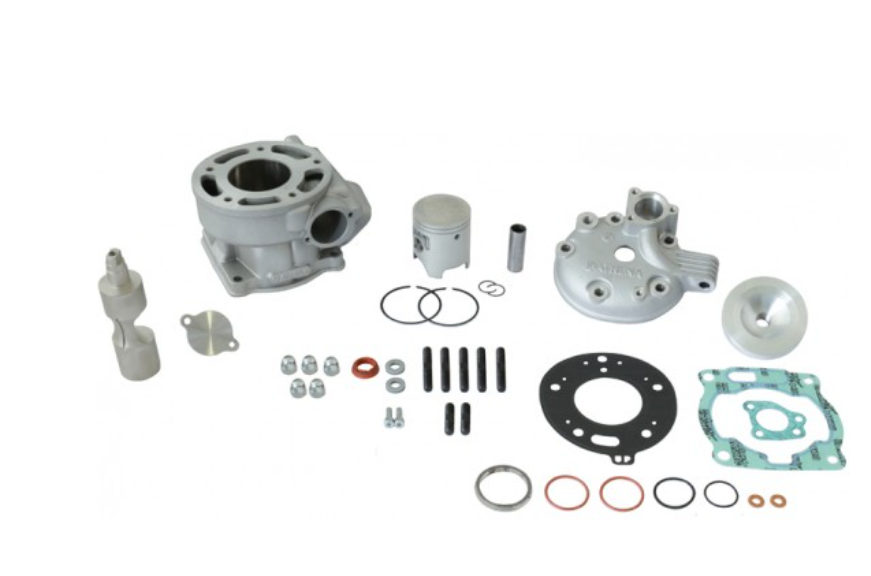
I've been looking for a new cylinder, and I found an Athena 125 cylinder kit for the DTX and was wondering if anyone here has first-hand experience with it. How does it hold up over time with regular use?
In terms of performance, is it actually worth it compared to the stock Yamaha cylinder, or would I be better off rebuilding an OEM cylinder instead? The price is almost the same.
-
I mean, Athena make some quality kit to be fair.
I bought their 392cc kit for my RD and the 170 kit for my DTR. I do think they're exceptional value for money though, especially as used units are getting expensive and prohibitively costly to repair.
Have a search on here as some members have bought them in the past.
-
I've been looking for a new cylinder, and I found an Athena 125 cylinder kit for the DTX and was wondering if anyone here has first-hand experience with it. How does it hold up over time with regular use?
In terms of performance, is it actually worth it compared to the stock Yamaha cylinder, or would I be better off rebuilding an OEM cylinder instead? The price is almost the same.
@Strike78 I bought one of those Athena 125cc cylinder kits and was quite impressed with it.
The plated bore should deliver better heat transfer into the water jacket and spare A, B and C-spec pistons are also available from Athena specifically for this kit (these literally differ 0.01mm in size to compensate for the minimal plated bore wear over time and so are worth obtaining, @calum I wonder if these are available for your 421 kit?). It eliminates the head gasket issues the DTR is prone to and you also get a brand new powervalve and all mounting hardware so it's ready to bolt on. I can't comment on the performance as I sold the bike shortly after building the engine (which also included a Zeeltronic installation) but the new owner seems very happy with it.
Roughly the same cost as repairing a stock cylinder as you say but you do need to factor in getting one or two spare Athena gasket sets and I'd also be ordering B and C pistons (I think it's supplied with an A piston but do check this) as the fact Athena supply these shows they've really thought about the implications of a plated bore. This is something you need if you want to take the performance of any two-stroke beyond a certain level; you can port the stock cylinder all you want (some of the guys in Portugal even make their own exhaust sub-ports in stock DTR cylinders) but if you can't physically remove the heat from the cylinder, it will just keep blowing up. This is why all modern MX bikes and bikes like the Suxuki RGV250 and Kawasaki KR1-S (both around 60bhp stock) have plated bores. Also the 2MA parallel twin TZR250 (50bhp) was OK with steel liners but the Japan-only 2XT version (an attempt to bring the TZR250 up to RGV/KR1-S levels) had plated bores.
-
Sorry for going a bit off-topic from the original post once again.
I've recently come across a brand new 3MB cylinder and I'm considering buying it. Would I need to make any modifications to fit it on my DTX, or is it basically a plug-and-play swap?
Sorry if it's a basic question, but I'm still learning about these engines and I'd rather ask before spending the money. Thanks for your help!
-
-
Hey everyone! It's been a while, but I've got some big updates
I've recently bought a used OEM carburettor, and the bike is running better than ever with the new cylinder at 57mm.
However, I've run into a new problem. If I leave the fuel tap open, it starts leaking fuel while the bike is off.
I've already replaced the carburettor seals, float and float needle, but the problem is still there.Has anyone had a similar issue or knows what could be causing it? I'd appreciate any advice.
Thanks!
-
-
Hello! It looks like you're interested in this conversation, but you don't have an account yet.
Getting fed up of having to scroll through the same posts each visit? When you register for an account, you'll always come back to exactly where you were before, and choose to be notified of new replies (either via email, or push notification). You'll also be able to save bookmarks and upvote posts to show your appreciation to other community members.
With your input, this post could be even better 💗
Register Login